Pages

Wednesday, April 17, 2013

Teaching at Kalende Mission College

For a few months now I’ve been teaching a class, every Tuesday and Wednesday at a small college
near my house. With only eight students I consider it to be just about the per­fect size
for my novice teaching abilities.
My students and myself in front of Kalende Mission College's sign.
Of the eight students and my­self, I’m the only one in my 20’s – the rest are all older than me, which is somewhat strangeto be the teacher when I’m essential­ly the correct “student” age.

This isn’t a typical class in a typical college though. The col­lege is a small Bible college where students from all over the North-Western Province of Zambia come to earn a theolog­ical degree.

The administration of the col­lege heard that I was in the area, tracked me down and asked if I would be willing to teach their first-year students in a life skills class. As it turns out, life skills in this part of the world mean agri­culture, so I happily agreed.

Every Tuesday and Wednes­day from about 8 a.m. to half past noon, I teach the students of Kalende Mission College
 about crop farming, gardening, for­estry and I’ve even sprinkled in some extra subject areas like fish farming, nutrition and ba­sic business skills.

So far, one term finished and midway through the second, I’m really enjoying the chance to teach in a more formal setting and have at least one structured activity during the week.


The teaching isn’t without its challenges though. At times I struggle with getting the sub­ject matter to neatly fit my time constraints. I seem to nearly al­ways go too short or too long for a period – never just right.

And I also have those mo­ments when my students try their hardest to stump me with a seemingly impossible or un­knowable question, and luckily I’m never too proud to say that I don’t know or that I’ll get back to them when I can findthecorrect answer – not something I make up.

It’s been a great experience and what makes the teaching so much fun are the students themselves. They genuinely seem to enjoy having me there.

And as the weeks pass I’m be­coming just that much more fa­miliar with each of the students and their individual personal­ities.

For example, when one stu­dent raises his hand I know to expect a very good question. And I know which student is most likely to fall asleep during a class; which student has the best humor; and which student needs a bit of an extra push and reassurance that he’s doing things correctly.

Teaching about beneficial trees (for soil improvement and food) or how mulching can pro­vide many substantial benefits to a gardener is good, but watching the idea click for them and seeing their eyes light up as if they have just made a great real­ization is the best.

Now I know what all those teachers from my years at Pennfield were talking about when they said watching a stu­dent learn was what made the job and their efforts worth­while.

My hope in teaching this class is that after the students learn from me, in my class, they’ll go back to their commu­nities and teach their friends and family what they learned.
I can imagine no better means of transferring knowl­edge and nothing would make me prouder or make my time and efforts here more worth­while. 

Monday, April 15, 2013

Photos From Kalende College

Here are a few photos from my time teaching at Kalende Mission College in Mufumbwe, North-Western Province, Zambia.
I try to add to the agricultural techniques that they already know.   This can be done by adding to existing knowledge or, like here, introducing a new system or tool - this bicycle plow.
This student, Oliver, had never had a field or garden before, but told me on the last day of class that he now felt confident he could manage at least a few garden beds.
To demonstrate certain topics I would have the students travel to my village and meet with other farmers that I work with.  
Here they're meeting with my good friend Mr. Nshimbi to see how a fish pond is built and managed.
Mr. Nshimbi, the one on the right, helped twice during the year to teach certain sections in the local language, so that the students would understand the topics that much better.
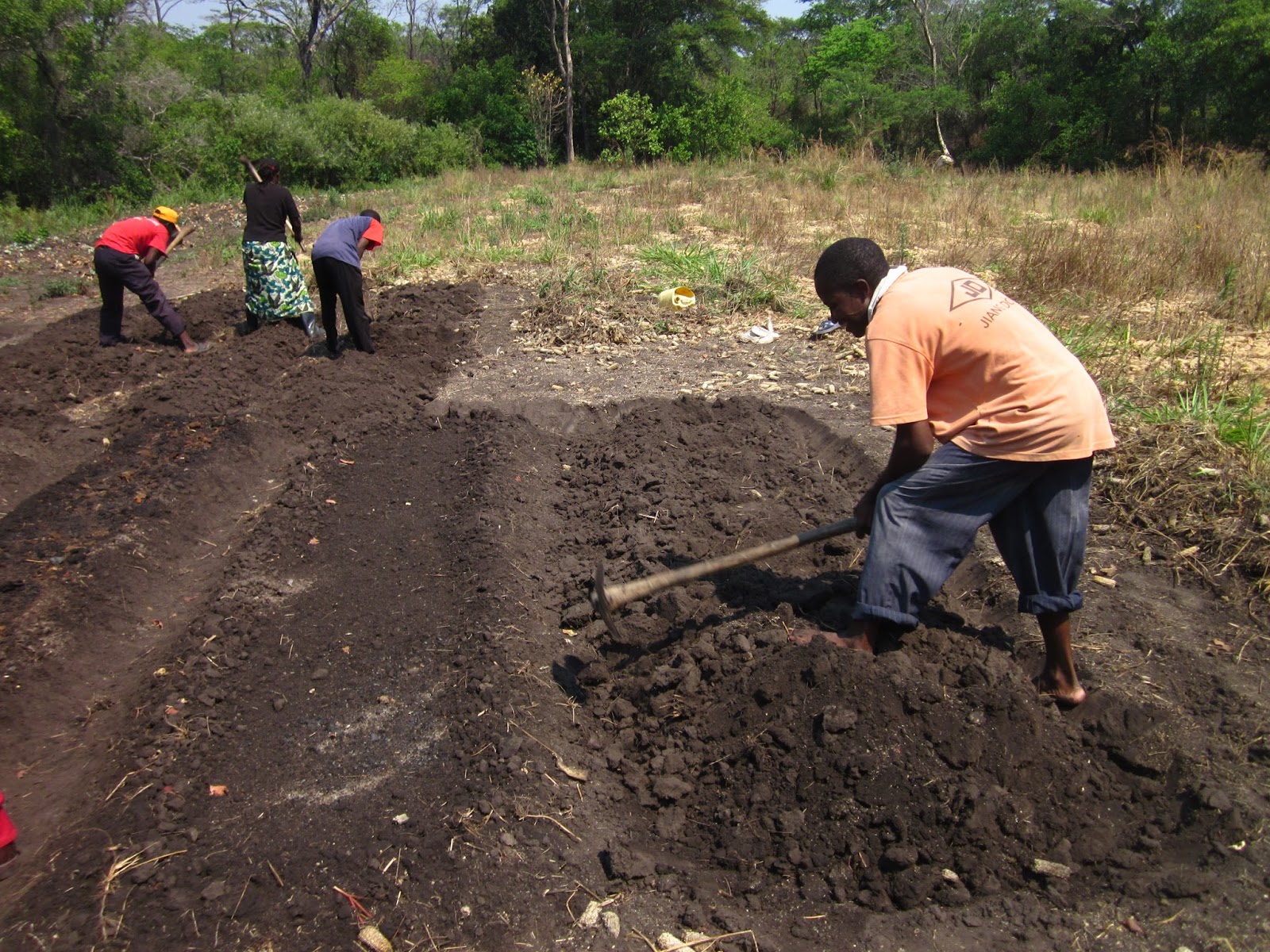
Gardening is a great way to improve food security and income in a rural setting.  The students had a lot of knowledge about this topic from their own personal experiences.  I learned a lot from them.

The man pictured here, Joel, was the smallest physically in the class but used the largest hoe.  No joke, it weighed at least 8 pounds.  
Here, Wilson, is mixing carrot seeds with sand  before sowing his garden bed.
Mr. Nshimbi, a fine gardener in his own right, came one day to talk about his personal experiences in regards to growing vegetables in Zambia.

Saturday, March 16, 2013

The Qualifications of a Peace Corps Volunteer

To become a Peace Corps Volunteer, a candidate needs to have certain qualifications.  These qualifications, at times, seem to me to be more like prerequisites and Peace Corps can seem like a continuation of my education.  I'll explain this later though.

My qualifications at the time of my application were that I had graduated with a bachelor's of science degree in Environmental Science and a specialization in International Agriculture.
Charlie went to college for psychology.  In the Peace Corps she's a public health volunteer where she works to prevent HIV / AIDS, malaria, and many other diseases and viruses faced in this part of the world.

Also, I’d been to Africa twice before, once as an intern on a wildlife ranch in Kenya, and I had even studied an African language for a year in college. Then after college I worked for a natural resource managing agency in Arizona. I thought I had the right stuff for this job -- on paper at least.
Currently, there are around 8,100 Peace Corps Volunteers serving in 76 countries, all of them featuring different skill sets and abilities. And although I’m sure most of them are very talented, I’m sure that none are 100 percent qualified for every aspect of this job.
Sometimes I think I went to school to be an agriculture volunteer in the Peace Corps.  However, my work ranges over a lot of subjects - a 100 years of college would not prepare someone for life in the Peace Corps.
You see, the job of a Peace Corps Volunteer is vast and diverse. One day I may teach a group of women about gardening; another day I’ll assist in the writing of a grant proposal; the next day I’ll plant some trees with kids, and the day after that I’ll go to the local health clinic and talk about malaria prevention. Work diversity is a main component of this job.
I once heard a volunteer that left early from Peace Corps Zambia say that he was overqualified for his job. Maybe for one aspect of it that was true. But for all? There’s just no way.
Because the work here is so diverse and widespread, all volunteers go through three months of training as soon as we come into Zambia. The training is half linguistics, half technical training (think of it as a crash course in forestry, gardening, and agronomy). And this is what I mean by a continuation of our education.
After this, we’re sent out with our prior experiences and education, our newly acquired knowledge, an armful of manuals and a whole bunch of ambition.
Throughout the two years of service, I’ll attend more trainings and receive even more education in areas like HIV/AIDS prevention, appropriate technologies, increased agricultural production and even how to facilitate meetings more efficiently.
Ryan went graduated with a degree in business.  Now in the Peace Corps he teaches how to build, maintain, and harvest fish farms. 
Yet the one resource that is most relied upon by myself are the other volunteers. There’s a vast cache of knowledge to be found in other volunteers and the Peace Corps’ staff. So while I may be a jack of all trades, more or less, somewhere, not too far from me, is an expert that can be called upon to offer advice and assistance when needed, and that’s an enormous benefit.
This April I’ll be returning to the place where I first trained as a trainee, but this time as a trainer. I’ll be doing my best to share what I’ve learned in my first year of service and give any advice that may be sought out.
Talking to a new trainee, Ryeon, about some of my experiences in my first year of the Peace Corps.
All in all, this job and its work (both development and cultural sharing) is a lot like building a house. We come to the job site with a box of tools, we’re given more and our colleagues have even more still.
It doesn’t matter which tools we use, but in the end what we’re after is that there stands a strong house, or in my case, that I leave my Zambian community better than I found it.

Training can teach trainees like these 4 a lot about what life may or may not be like in Zambia, as well as the types of technical knowledge they'll be expected to share, but nothing can fully prepare anyone for life in a small African village.