Pages

Wednesday, January 28, 2015

The Great White Place

Covering an area over 8,000 square miles, Etosha National Park is a wildlife sanctuary like none other, at least as far as I’ve been fortunate enough to see.  Etosha sits in the Northern region of Namibia – a very dry, very dusty place where seemingly nothing would live.  But, in fact, a lot lives there - from cheetahs to lions to elephants to rhino to numerous other mammals and birds.  It’s an oasis of life. 
 
The Etosha salt pan is made up of millions (probably billions?) of these little clay polygons.

The name Etosha means “Great White Place,” and although the entire park is not one huge salt pan, the main point of interest in the park is the Etosha salt pan, which measures slightly over 30 miles across by nearly 80 miles wide.  When the park was originally established in 1907 its area covered over 34,000 square miles from the Skeleton Coast to its current location, but after many size adjustments the park was reduced to its much smaller, current size; which is still seven times the size of Rhode Island.

My friends and I traveled to Etosha for one reason: the wildlife.  In particular we wanted to see cheetahs and desert elephants, and although the cheetahs eluded us over the four days we were in the park we were able to see plenty of elephants.  
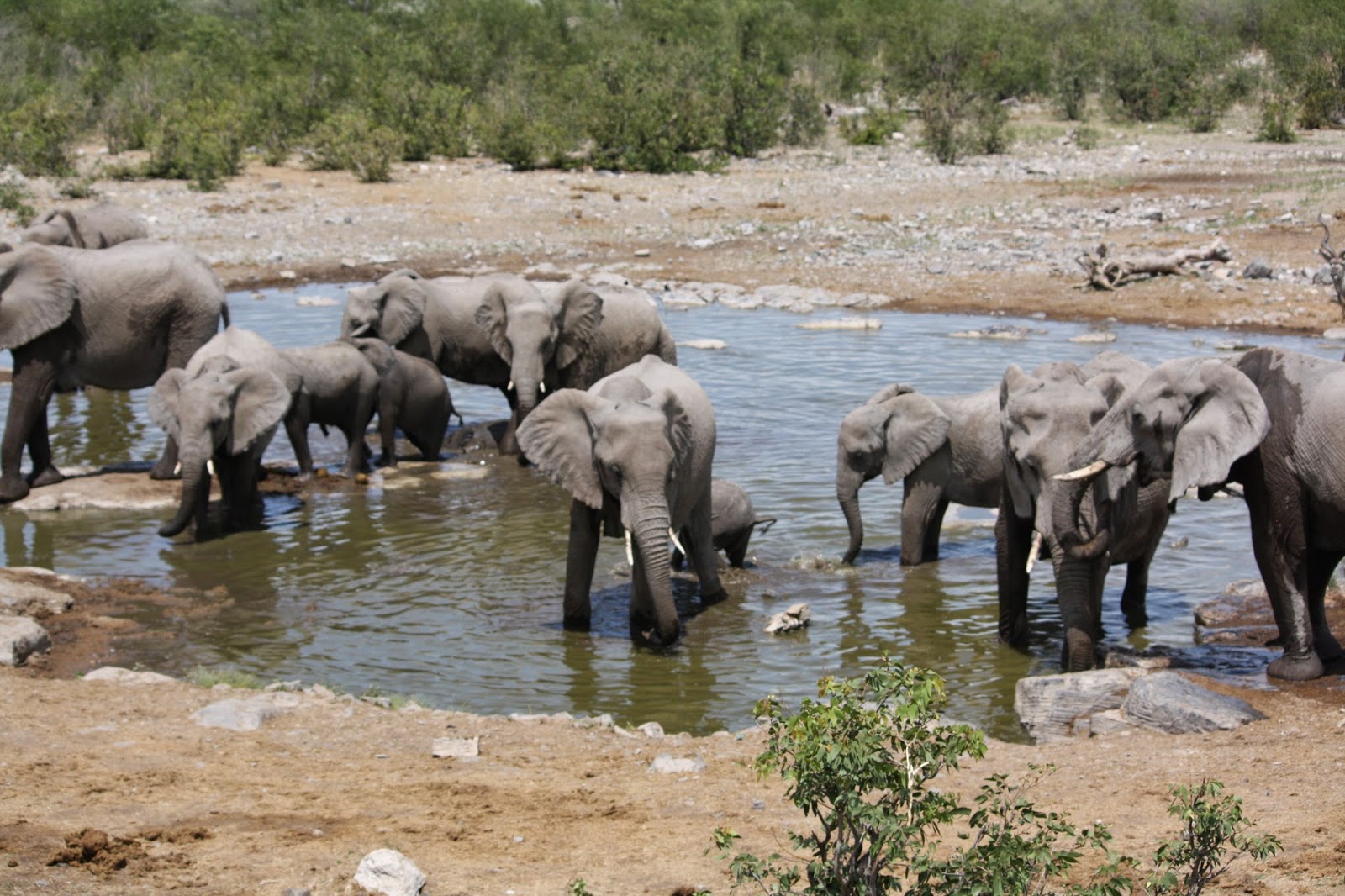
Some of the 16 elephants that we saw at the watering hole in Halali.

The elephants of Etosha are a wondrous bunch.  These elephants belong to a special group of elephants found only in Northern Namibia and Southern Angola.  The elephants are taller than their counterparts from other parks, yet lack the large tusks that distinguish the elephants of Southern Africa and Eastern Africa due to a deficiency of minerals in their diets – causing smaller, shorter tusks.

A mineral deficiency (probably calcium) causes the elephants of Etosha to have smaller husks, although the elephants are the tallest in all of Africa.

Calves like this are at the center of the herd's attention and although this is the time they're most likely to be killed by lions, the entire herd will make a very intimidating wall of bodies and legs should a predator be found nearby.

Living in Etosha’s arid environment comes with other challenges aside from a lack of particular minerals.  Namely water is the limiting resource for these large consumers and because of this their numbers hover between two to three thousand in total for the park, whereas Chobe National Park (a park of similar size) just some few hundred miles away has an estimated 50,000 to 80,000 elephants.  

Luckily, the lack of water sources lends itself to increasing the numbers of elephant sightings due to the fact that elephants must drink water nearly everyday, so to see them a person only needs to go to a watering hole and wait.  Patience will bring the elephants.  During my time in Etosha we saw over 40 elephants, but at a waterhole in Halali we saw 16 at once.  

In Etosha National Park, water is the most limiting factor in why such a large park only has two to three thousand elephants, where as Chobe National Park in Botswana has at least 50,000.

What makes elephants so interesting to watch is that elephants exude many of the same mannerisms that humans do, while other animals – impala for instance – just go about their time grazing and walking around.  Elephants are far more interesting because they’ll play with each other, chase other nearby animals, actively reach out and touch one another, are inquisitive, and even coddle their young.  
 
Watching these 16 elephants at Halali for a couple of hours was the highlight of my time in Etosha.  We saw two male rhino fighting one another, lions stalking springboks, but the elephants - in my opinion - were the best.

I’ve seen plenty of elephants during my time in Zambia, Botswana, Kenya, South Africa, and Tanzania but I would have to say that the elephants of Namibia’s Etosha National Park were my favorite.  It can’t be an easy task to scratch out a living in a park that’s known for 2,400 square mile salt pan and allows nothing to grow.  

Overall, I would go so far as to say that Etosha as a park ranks second on my list of parks that I’ve been fortunate enough to visit (it would be second only to Kenya’s Maasai Mara Nature Reserve).  And to have the opportunity to stand in the middle of a “Great White Place” where the air is as dry as anything you could imagine, while having lunch with friends, is a memory I won’t likely forget anytime soon.  

In the middle of Etosha Pan.  From the left: Jacob, Team, Caleb, myself.

Friday, January 23, 2015

A Tree for Multiple Generations

If I ever write a book about my time in the Peace Corps I might think to call it Living Among the Mangoes because that’s exactly what I did for my first two years in Zambia.  My small hut was hidden away beneath three mango trees and my village as a whole was the same setting with mango trees looming over us everyday.

My compound's three mango trees.  I loved sitting beneath them where it was infinitely cooler than being in the sunshine.

Mangifera indica.  That’s the botanical name for the Indian Mango, the most commonly found mango tree in the world.  Over 400 varieties of mangos exist in the world, but this one is the most commonly seen in Zambia.

Mango season is the time when the villagers around me were most likely to be without food (November until February) during a time called the "hunger season."  The mango tree’s fruits help to alleviate the impact of hunger everyday, as well as providing a good source of Vitamins A and B - two essential nutrients that children in this area are greatly lacking during hunger season.

I have a theory that villagers hardly ever, I mean nearly never, cut down a tree that provides them with food - especially a tree in which they’ve invested the energy of planting and caring for.  A prime example of this is when crossing the border into Malawi where an enormous population has led to huge amounts of deforestation, but guess which tree is always standing strong throughout the fields and villages – the mango.  

As soon as kids get out of school they head up into the trees to look for mangoes - a delicious, sweet after school snack.

There are other fruit trees grown in Zambia like papaya, orange, lemon, guava, and every once in a while cashews and peaches can be found.  But, mango is by far the most common.  There are two kinds grown largely in Zambia: a small mango, about the size of a fist, and the big mango – two fists.

I had to make a deal with the kids in my village because being the little scavengers that they are they can go through an entire mango tree in two weeks (even the unripe mangoes they’ll destroy), so I told them they could have as much as they could gorge off of two of my mango trees, but I wanted them to leave half of the third one for me – the other half was communal.

With their tiny faces poking out from time to time, I was always assured a few mangoes for myself once the kids went up into the trees.  There they would climb, sing, pick mangoes, and shake the branches until they had more than they could carry.

The mango tree is so great for food security because even in times of drought its deep roots can tap into ground water reservoirs far down into the Earth, and even when there isn’t water near the surface, the mango tree will keep churning out fruits.  A typical tree takes about 7 years to mature and produce fruit, but will live in excess of 30 years, which is long enough for it to feed multiple generations.

Carrying the day's bounty.

There are special varieties of mangoes from Kenya and Tanzania that can be grafted onto local trees and produce all different kinds of mangoes: red, big, yellow, etc., but they’re less commonly found.  Instead we see the previously mentioned Indian mango.

Locally, planting mango trees is tricky because without a strong fence goats will destroy the seedlings.  However, the mango tree’s pits sprout all over the place, with little effort, ensuring that mango trees will continue to feed future generations.

My half of the tree remained with mangoes for much longer than the communal half.  Even green, unripe mangoes will be eaten by the kids.

All of this has led me to my belief that the mango tree is the most important tree in a village, maybe in all of Zambia and the region.

Eating mangoes during the rainy season will always remain as one of my favorite memories of the village.
Fun fact: My personal record for mangos eaten in one day is twenty, and I think if I would’ve started earlier in the day I could’ve managed a good thirty.  

Wednesday, January 21, 2015

World Heritage Sites with the "World's Greatest"

During my trip to Namibia for New Year’s I was informed by Team Chen, a friend of mine on the trip, that he was “The World’s Greatest Explorer.”  I doubted this, as did the other two guys on the trip.  But Team kept on about how he was the Greatest and in the end I have to admit that he did point us in the right direction of a great find when he suggested we visit the petroglyphs of Twyfelfontein.  

Walking from the parking area to where the petroglyphs were carved.  The Twyfelfontein area is barren and arid.  The Skeleton Coast is less than 75 miles from where we were, but that didn't help.  Rain hadn't fallen in the area in over three years at the time of our visit.

Lying some hundred and twenty kilometers or so from Namibia’s infamous skeleton coast is a place called Twyfelfontein, which in Afrikaans means the “Doubtful Fountain.”  It was so named this because the original European settler in this area would always remark that he was doubtful the local spring would produce much water that year.  Sure enough it didn’t and he had a pretty dreadful time making a living there. 

The original white settler's home... or at least what remains of it. 

He wasn’t the first inhabitant of that area - far from it actually.  Long before him, and even now, there are a lot of indigenous groups calling the Doubtful Fountain their home.  While living there they created timeless works of art, which were the reasons for us even wanting to drive out there in the first place.  

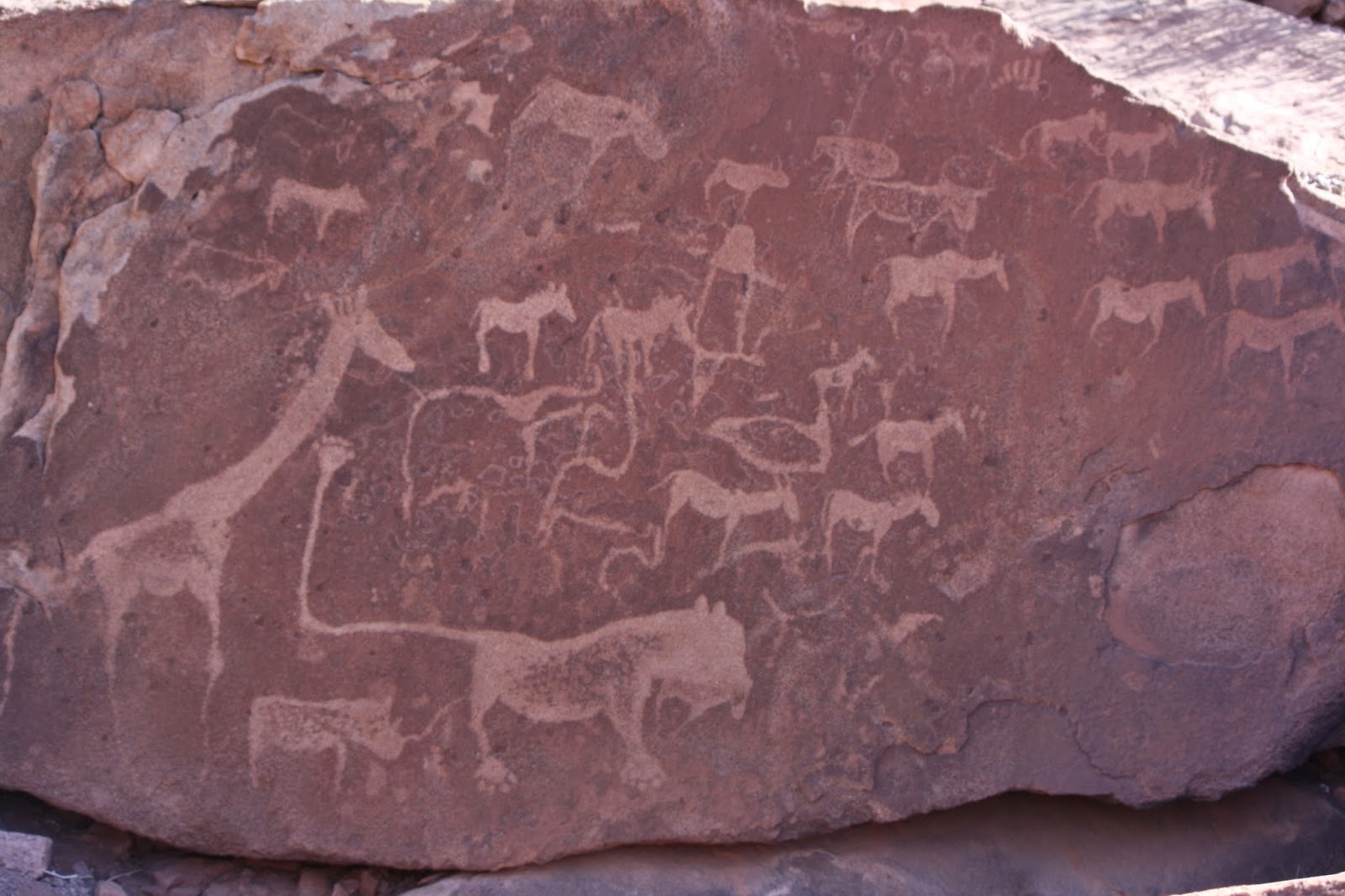
A couple of giraffe and a rhino were etched between two to five thousand years ago on this panel.

Led by Team’s notion that this is something worth seeing and fueled by his desire to see “every UNESCO world heritage site on the planet… there’s only a few thousand” we exited the car and hired a guide named Sylvia.  During our hike with Sylvia we saw seven panels of petroglyphs that ranged from two to five thousand years old.  As it turns out the petroglyphs were used as an indicator from one passing hunter to another of what prey had been seen in the area at one time or another.  This caused some confusion for me because I wondered aloud, “Well, if they’re so old how was a hunter able to tell the difference between what was there 1,000 years ago compared to just 10 years ago?”  

Sylvia being a boss and breaking down petroglyphs for the four of us.  One of the best guides I've ever had on a tour - anywhere.

Sylvia was on it!  She said the hunters were so experienced that they would’ve been able to tell the difference between the newer carvings versus the older ones.  The carvings themselves were amazing: rhinos, lions, elephants, giraffes, human footprints, and even seals were carved by hunters from long ago.  (Seals can be found on Namibia’s Skeleton Coast some 100+ kilometers away).

Here is a very old giraffe carving with human footprint carvings flanking the two sides of its neck.

As it turns out, during our time in Namibia the four of us visited the only two world heritage sites in the country (the other being the Namib Sand Sea), which puts Team (and the other three of us for that matter) on the right track of visiting all the really important sites that give human existence on this planet some meaning and context.


Team "The World's Greatest Explorer" Chen on the left, Jacob Johnson sitting on the UNESCO Heritage Site Marker, Caleb Rudow looking too cool for school on the right, and myself made up this Namibia expeditionary group.

Additional Pictures of the Petroglyphs at Twyfelfontein:

This petroglyph panel features a lion, multiple giraffe, wildebeest, hartebeest, and other animals found in the area.

Us (Caleb, Jacob, Team, and I) with two German girls that we basically stalked through Namibia.  Everywhere they went we would show up about a day later and camp right next to them (we did not intend for this).  They were good sports about it.  And on this day we bumped into them right there at the petroglyphs.

A blue wildebeest carved into a stone face.

A giraffe carved into the rock.